
ARotS Lab.
Research Area:
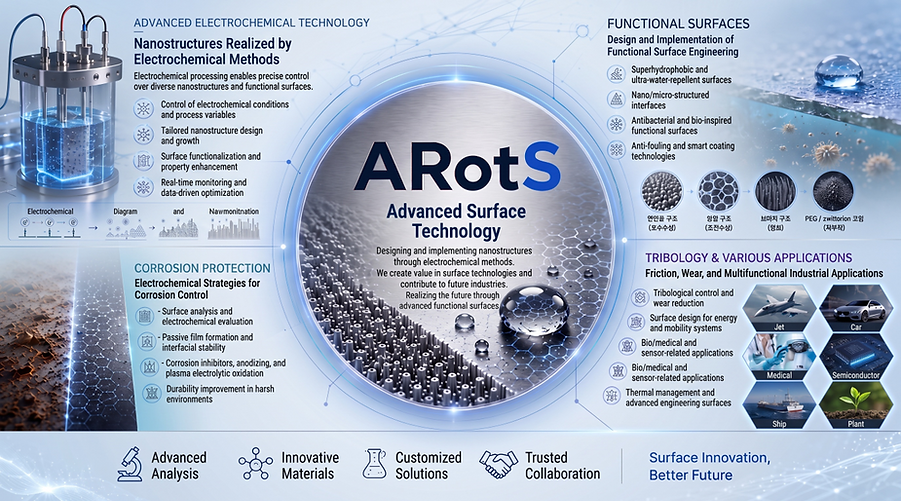
Research Interests:
• Electrochemical Surface Engineering
• Corrosion and Durability of Engineering Materials
• Functional Oxide Nanostructures and Anodization
• Surface Wettability and Protective Coatings
• Sustainable Manufacturing and Surface Functionalization
• Materials Characterization and Interface Analysis
• Machine Learning-Assisted Materials Design
• Additive Manufacturing and Advanced Metal Processing
• Biomaterials and Biomedical Surface Engineering
• Aluminum, Titanium, Magnesium, Stainless Steel Alloys, and Copper-based Alloys
Professional Activities & Affiliations
• Member of the Electrochemical Society (ECS)
• Member of Korean-American Scientists and Engineers Association (KSEA)
• Executive Director of Corrosion Science Society of Korea (CSSK)
• Editing Executive Director at the Korea Institute of Surface Engineering
• Peer Reviewer at Applied Surface Science (Elsevier)
• Peer Reviewer at Applied Materials and Interfaces (ACS)
• Peer Reviewer at Materials Performance and Characterization (ASTM International)
• Editor at Coatings (Recent Advances in Functional Surfaces & Interfaces)


Nanoengineered Superhydrophilic Metal Surface
Nanoengineered Superhydrophobic Metal Surface
1. Electrochemical Surface Engineering & Advanced Manufacturing: Anodizing, electropolishing, electrochemical processing, nano/microstructure fabrication
References:
- J. Kim and C. Jeong*, Research on Variation in Nanopore Parameters and Surface Characteristics of Anodic Aluminum Oxide (AAO) Films with Time-controlled Anodization Processes”, Journal of Materials Science 59, 10556-10571 (2024)
- C. Jeong et al., “Control of the Nanopore Architecture of Anodic Alumina via Stepwise Anodization with Voltage Modulation and Pore Widening”, Nanomaterials, 13 (2), 342 (2023)
- C. Jeong et al., “A Study on Functional Hydrophobic Stainless Steel 316L using Single-Step Anodization and a Self-Assembled Monolayer Coating to Improve Corrosion Resistance”, Coatings, 12 (3), 395 (2022).
- C. Jeong et al, “Systematic Control of Anodic Aluminum Oxide Nanostructures for Enhancing the Superhydrophobicity of 5052 Aluminum Alloy”, Materials 12 (19), 3231 (2019).


2. Functional Surfaces & Interfaces: Wettability, adhesion, antibacterial/antifouling surfaces, structural color, thermal management
References:
- Y. Choi and C. Jeong*, “Investigating the Influence of Pore-widening Time Control in Electrochemical Anodization for the Formation of Hybrid Titanium Nanostructures with Enhanced Superhydrophobicity for Improved Corrosion Resistance Efficiency”, Electrochimica Acta 492, 144380 (2024)
- C. Jeong et al, “Systematic Control of Anodic Aluminum Oxide Nanostructures for Enhancing the Superhydrophobicity of 5052 Aluminum Alloy”, Materials 12 (19), 3231 (2019).
- C. Jeong et al., “Single-Step Direct Fabrication of Pillar-on-pore Hybrid Nanostructures in Anodizing Aluminum for Superior Superhydrophobic Efficiency”, ACS Applied Materials and Interfaces 4 (2), 842-848 (2012).

3. Surface Durability & Protection: Corrosion resistance, barrier oxides, coatings, environmental durability
References:
- Y. Choi, J. Kim and C. Jeong*, “Optimization of the Barrier Oxide Layer to Enhance Long-term Corrosion Resistance of SUS 316L Stainless Steel in 3.5 wt% NaCl Solution”, Journal of Materials Science 60, 8148-8169 (2025)
- Y. Choi and C. Jeong*, “Investigating the Influence of Pore-widening Time Control in Electrochemical Anodization for the Formation of Hybrid Titanium Nanostructures with Enhanced Superhydrophobicity for Improved Corrosion Resistance Efficiency”, Electrochimica Acta 492, 144380 (2024)
- C. Jeong et al., “A Study on Functional Hydrophobic Stainless Steel 316L using Single-Step Anodization and a Self-Assembled Monolayer Coating to Improve Corrosion Resistance”, Coatings, 12 (3), 395 (2022).
- H. Ji and C. Jeong*, “Fabrication of Superhydrophobic Aluminum Alloy Surface with Hierarchical Pore Nanostructure for Anti-corrosion, Corrosion Science and Technology 18 (6), 228-231 (2019).
- C. Jeong et al., “Air-Impregnated Nanoporous Anodic Aluminum Oxide Layers for Enhancing Corrosion Resistance of Aluminum”, Langmuir 31 (40), 11040-11050 (2015).

4. AI-Assisted Surface Design & Process Optimization: Data-driven process–structure–property relationships, prediction, inverse design
References:
- S.-H. Kim and C. Jeong*, “Feasibility of Machine Learning Algorithms for Predicting the Deformation of Anodic Titanium Films by Modulating Anodization Processes”, Materials 14 (5), 1089 (2021).


5. Technology Translation & Industrial Applications: Batteries, automotive, semiconductor packaging, consumer electronics/appliances, biomaterials, marine and aerospace applications